The Frenzy, by Keith Law

I am pleased to be able to share Keith’s latest work with our readers. This was a really fun read about the run up in silver prices at the peak of the market. Enjoy!

FORWARD

In response to a few younger people’s questions here in B.C., who were not alive in the 70’s, I have written this story of the craziness of the markets in the 70’s as we headed to the 80’s, and then the fluctuations leading to a silver high again in 2011.

50 years ago, as I was getting to the height of making silver bullion, we were selling silver bars, with the fabrication charge included, between $50 – $60.00 / Troy ounce CDN. We did get close back in 2011, in terms of CDN dollars, but, there still must be thousands of ounces still sitting in people’s possession. Very few bars, in reality, came through for refining in my years at Engelhard and Technic.

For all you collectors that visit this site, my next story will address how you got your bars, especially the earlier ones. From the scrap coming in the door, refining, and then going back out the door as bullion bars.

I hope you find this bit of history interesting.

Keith law

THE FRENZY

Fren-zy (noun) : A state or period of uncontrolled excitement or wild behavior.

I heard the truck before I saw it. 

As I set the first coffee of the day down on my desk, the rumbling 318 C.I.D, dusty and dented Dodge Power Wagon pulled into the parking lot, leaving a blue haze of burnt oil behind. The exhaust belted one last fart of oil smoke out, as the driver turned the tired engine off, as if to say…”I made it!” 

The driver seemed to peel himself out from behind the steering wheel, as did the two passengers, all looking like they had not slept in days. They too, like the truck, were covered in dust and mud on their coveralls. They headed to my door.

This will be interesting I thought to myself, and, as it turned out…. was it ever! This group of men had arrived at the front door of our business at the peak of the “Frenzy.”

The “Frenzy” as we called it did not start off with a bang; it was a slow crawl until it really exploded as both the gold AND silver markets peaked in the early 80’s.

In previous stories I have talked about the building of the jewellery business at Delta Smelting. We were also trying to gain entry into the photo processing businesses and film developing labs, in order to increase our silver refining potential, along with investment bar production. Being a brand new company, it took some marketing to get us known to the Vancouver market.

Our brilliant idea came with the making of a portable display, to be taken to all the malls that were starting to pop up in the 70’s. We would run an ad in the papers the week before. We had crucibles, our safety gear, pictures of refining procedures, a small sluice box, and, a larger one in which people could pan for gold. We could tell people who brought material to us what they might get for their scrap gold and silver. We had samples of gold and silver scrap on a display board.

The attached picture I took was in 1975 in the Capilano Mall, in North Vancouver. You can see on the sign board silver was $4.20 CDN and gold was $155.15 CDN. Also on the display board you can see samples of articles that might contain gold or silver. This really piqued the interest of people, as it made them aware of what might be lurking in the desk drawer or jewelery box.

When I started with Delta Smelting in 1969, silver was valued in the $1.80 Troz range. As we headed to the 1980’s, the price of silver rose dramatically. Surprisingly, the price rise was being triggered by the HUNT BROTHERS, trying to corner the silver market!

It was not until after the terrible fire we had in 1973 that we actually put in a small sales and receiving room. In conjunction with our advertising and business name being established with the jewellers and pawn shops, we now had the beginning of what was to become the “Frenzy” of people coming to unload their personal treasures. 

In 1971 Richard Nixon took the U.S. off the “gold standard” thus beginning the sharp rise in market prices. Gold went from $40.00 USD to $161.00 USD by 1975, silver from $1.54 to $4.43, …..quite the dramatic increases! 

People started to come to the plant with a few sterling silver bits; watches, the odd trophy, etc.. The flood, or finally, the Frenzy had begun! With the price increase, and the public’s growing awareness of how highly valued silver and gold had become, it was GAME ON!

Now, here was the reality….everything HAD to be checked before it was officially received. Why you may ask? Because not everything was sterling silver or karat gold! So many things were plated silver/gold, just a coloured alloy, or just plain fraudulently stamped on an article.

We in no way wanted to take anything that the customer THOUGHT was sterling, and then tell them 50% of it was not! 

As the company headed to the late 70’s, silver was hitting $11.00. The knowledge of the price was now out there and with that, our small sales and receiving room required two more employees. We trained them in all aspects of testing and receiving items.

Imagine someone shows up with a complete 12 place serving set of sterling silver, more often as not in a beautiful red or blue velvet lined box, plus tea/coffee pots, small dishes, little serving forks, spoons, and candy trays, etc.. We would have to look at all the marks stamped on the article, then, do small “scratch” tests and put a small drop of nitric acid on it, so see what the reaction would be. If it bubbled, it was NOT silver!

This all took time, even taking an hour plus to go through one person’s silver….or gold articles. We got to know the major silver manufacturers, so for some it was quite easy, as we could trust the silver maker’s marks. At times is was a very BIG disappointment for some people, as the article was stamped

E.P.N.S.; Electro Plated nickel silver, or N.S.; Nickel silver, Pewter, NO silver at all, just plated. The attached picture of my tray shows the marking and the silver plate being worn off. I serve coffee when camping with this tray! Ha!

Also, as we found out, the bases of so many things included plaster of Paris, or resin. This was done to fill the voids, add strength to the items and to keep things upright as a weighted base would do. Steel plate was also used a lot, before the final silver sheet was put on to seal things up. BIRKS ring boxes had a steel base in every one. This presented a bit of a problem because we had to explain to the customer that the box had to basically be destroyed to determine the actual received weight of scrap silver. The knives in the serving settings all had a steel shank, but, were filled with plaster of Paris or resin in the handles. Therefore it was a major job to break the handle away from the steel blade/shank, and then pound the silver handle to get the filler material out.

Ring Boxes

One of the worst offenders for fraudulently stamped silver was Mexico. People would bring in the so called “sterling silver” they bought from the vendor on the beach, sometimes a whole collection from many trips over the years. They would have the 92.5 stamp on them, but, it was just a cruddy alloy that looked silver. As we would say to many people,…ANYONE can buy a stamp.

The magnet was our true friend, as it would grab any plated item or alloy that was magnetic. So many chains were just plated, and charm bracelets were the worst at times.

As the Frenzy built, the time it took to check things increased. By then the line up out our front door stretched the length of the parking lot. One day I counted no less than 55 people waiting to bring their material in. We also received a lot of gold articles and again, the checking process would have to happen. This is when I built my pocket watch collection, as most watches were gold plated, or, rolled gold, which is a form of thicker plate. The watches were works of skilled American craftsmanship, and, a symbol of a dying and soon to be a dead industry. Having come to appreciate them I would make an offer to buy them for my personal collection. Most were from the late 1800’s to the mid 1940’s. The railroad watches were the best find, as they represented the best of quality and reflected a change in the railroad industry after a massive train wreck in the U.S.. This head on collision was caused when two engineers, on separate trains, had used unsynchronized watches with no timing or standards, which were three minutes out. A bit of trivia for you: The investigation had a man named Webb C. Ball hired to investigate the use of watches on the railroad lines. This investigation led to the rules and standards that watches had to meet for the railroad. This event popularized the phrase; “On the Ball.” 

Our company moved to a new building on Shell Road at the height and culmination of the Frenzy, as silver hit a high in 1979 of 11.07 and finally hitting 20.98 in 1980. The price in CDN dollars, for silver bullion that we sold in that time period, was between $50.00 to $60.00 per TrOz. The Hunt Brothers, in the back ground, had bought up 100 million ounces of silver, almost 1/3 of the world’s silver at the time!

This Frenzy also had people bringing in ANYTHING they thought could be silver or gold. It just got crazy, as again, everything had to be checked.

As I wrote about in my story; “TREASURE”, the articles that came in were astounding at times. They were truly fine works created by talented silver smiths, such as hand crafted candelabra, trophies, dishes, serving trays, and so many Art Deco pieces from that time period. Many times we would try to advise people to take their items to an Antique dealer. Often times, customers returned to us, stating that the dealer was more interested in the price of silver than the object itself. It made me, and my co-worker Evan, so sad to have to smash and cut up such historically beautiful things in order to fit them into the melting pot.

To destruction…
Destruction

All to be melted

Off to melt…

Items rescued from the melt pot

On a daily basis people started to arrive early, to be in the line up, a few fights almost broke out. As the price of silver fluctuated on a daily basis, it was often difficult to give customers the payout they expected by the time assays and sales were completed. We would explain the whole process, but at times we would have to phone the customer if the silver price had bounced down, to confirm a sale or not. The customer had the option to withhold sale until silver price was to their liking. Silver and gold are “hedged” the day of sale.

For all you owners of early Delta Smelting and Wessex bars, know, that most of your silver came from BIRKS, ENGLISH and American sterling.  Mexican coin silver was also huge for a year or so. I previously wrote about a fellow that had a contract to buy old 1920’s silver coinage. He brought in 1,000’s of ounces to Delta for refining. He was doing very well until he augured into the Arizona desert when his DC-3 crash landed. Unfortunately, he was transporting a load of marijuana as well as the silver. 

As we now had the photo finishing labs, x-ray film and news paper silver sources, bars would be a mix of all these things. Long before the digital age, Vancouver had two very large movie film processing companies. These companies, along with every photo store had their own silver recovery cartridge. This gave us thousands of ounces on a weekly basis, all ultimately going to bullion bar production and of course the silver content of gold karat alloys. I also made hundreds of ounces weekly of sterling silver casting grain to go back to the jewellery industry.

At times there were both some sad and some funny stories to go with what people brought in. There was a period when counterfeit U.S. Morgan Silver dollars came into the market. People thought they were getting a “good deal” when they were purchased. Ironically, these “dollars” had zero silver in them. We turned away dozens of persons who brought them in.

With gold at $300+ by 1979, then jumping to 612+ in 1980, the “weekend gold panners” started to hit B.C. creeks and rivers with a vengeance. This brought a flood of them coming in on a Monday, after panning their hearts out for two or three days.

They would carefully show us their bottle of “gold”, then, I would have to tell them it was “Fool’s gold!” The look of shock was both funny and sad at times. I would ask did you not do some home work as to what placer gold really looks like!? I got to where I kept a small vile of #16 mesh at my desk to show them what real gold looks like. Most laughed it off, but, there were a few that did not believe me and I would just say, “Take it to an assay lab then!”

We now turn to the story of the ton of “gold” in the pickup truck, both hysterically funny and tragically sad! The material in the truck weighed 2,342 lbs, as they had stopped at a weigh station outside of Hope, B.C..

The three gentlemen headed to my door, stretching out some obvious kinks in their arms and legs from being cramped into that cab. I headed to the door as they hit the door buzzer.

As I opened the door, the obvious leader of the group, asked, “Is this the gold refinery?” He introduces himself as “Bob”. I say yes and invite the three men in. They ask if I have any security that could go and guard the truck, as there is GOLD in there, with emphasis. I of course, invited them to bring it in.

Now, at the same time, the middle passenger, Garry, who was quite a bit younger than the other two, started talking to the other fellow about how they had finally had finally MADE IT! Such a long drive, over 12 hours in the Dodge. The other fellow, Harry, started on about how he did not think the truck was going to make it to Richmond, and that the next thing he was going to do was buy a NEW truck. 

The younger lad started talking about the Ferrari he is going to buy. As I am a car guy, I asked what Model, etc. He says a Ferrari 308 GTBi, which at the time for that model was over $88,000.00+ CDN. I’m thinking they must have hit the jackpot!

Meanwhile Bob, has caught his breath and asks if I can handle a TON of gold. WOW….a TON of gold….that gets my attention!
I ask so where is it? My red flags always go up when that has been asked of me. I confirm that would be no problem.

At the same time, me being the car guy that I am, the young fellow has been telling me the specifications of the Ferrari, how fast it is going to be, and how he has been dreaming of and planning the purchase for the last month.

Bob and Harry now start to tell me they have been working on a “bluff” they discovered while scoping out some fall deer hunting area. To their amazement, they believed they had discovered a vein of GOLD!! In haste they went back with tools, and dynamite.  A week later they had set up camp, where they blasted and sweated for the whole month, baking in the sun.

They of course keep stating they have a ton of “gold” IN THE TRUCK!

Now, in 1983 when this happened, gold was around 400.00 US, so based on the potential weight they stated, worth some potential 13 million….I choked on my coffee!

“Let’s go and take a look!” I said.

On out to the truck the four of us went. I climbed up onto the back bumper and looked into the bed of the truck; they had made some “stake sides” to raise the height of the bed. There, in the bed, were three layers of white five gallon plastic buckets. They filled the whole back, maybe 30 – 40 of them.

I asked; “Where is the gold?”

They said; “You are looking at it!”

I stood there on the bumper, processing what they had said ….then, the light came on…..I jumped down, looked at the three of them and broke into hysterical laughter!

“IT’S FOOL’S GOLD!! “IRON PYRITE!”

Beautiful mineral samples of iron pyrite!

I caught myself, and stopped laughing, as they were really upset. I could now see what happened. They had NO idea what they had actually mined, spending all that money on food, dynamite, fuel and a whole lot of Wobbly Pops.

They of course did NOT believe me. I asked them….”Why, on an old logging road, when it was so easily seen, would this not have been found and mined before…if it were gold?” Our Province has been gone over by prospectors for 200 years; there is no way an out cropping such as this would have been missed.

I had them come back inside, after taking a few small samples, to show them why this is not gold. I explained that when I put a small piece on my testing watch glass and put a drop of nitric acid on it, the sample will bubble, emit a brown gas and DISSAPEAR! I also showed them with a real small mesh piece of placer gold. The two older fellows still did not believe me. I said I have nothing vested in this other than the truth, take a sample to a certified assay lab in Vancouver, of which there were at least six at the time. Of course the sample just disappeared in the nitric acid test.

This is where it got so sad for me; Garry now realized what a massive and silly mistake they had made. He now believed me.

I can still see him to this day, pushing his dark green John Deere tractor hat back on his head, which was now nodding back and forth,  then getting down on his haunches and repeating….”It’s Gone, it’s gone, it’s gone!!!” What he meant was that his dream of the Ferrari has just vaporized, like the truck of gold.

I like to think the other two finally did believe me as they departed, but, they soundlessly left the building. Garry chose to leave me the two nice samples of “Fools gold” which I have to this day. He finally understood the truth.

Versions of this still happened over the years, not as big, but, as the Frenzy continued, so many people bought things that were not gold or silver.

This story covers from the mid 70’s and through to my retiring in 2018, similar Frenzies happening as the prices rebounded after slumps. When the Hunt Brothers were caught, silver dropped from 21.00 to 10.00 by 1981 and a low in 1982 of 7.92. It bounced up in 2006 to 11.55 then headed to 35.00 in 2011, thus starting another major run of scrap.

We also had the Cash Buyer business model come to the forefront.  Online companies and night time TV shows said “Send us your scrap from your jewellery box, and we will send you CASH!” Mobile cash buyers were touring many cities at a time on purchasing sprees. You may have gotten a flyer from the cash buyers in the mail. Many antique dealers and pawn shops too got flooded with silver and then sold to us.

Each price jump had the Frenzy all over again, as the next age demographic went through the jewellery box or got rid of Grandma’s gift of her sterling silver. These cash buyers sure took the strain off us though, no more line ups, as they did the work and we still got the silver and gold.

When I retired in 2018, staggering amounts of silver kept coming into our business on a monthly basis. This was a historic testament to our British and European roots in B.C..  We also received silver manufactured by other cultural groups such as, East Indians, Persians and Asians.

Will there be another Frenzy like the past? Who knows, who could have thought that gold would go from $35.00 U.S. when I started, to $2,146.00 U.S. ($2,756.00 CDN). Who would have predicted silver going from $1.80 U.S. in 1969 to $35.00 U.S.

In 2011?

 With an alleged deficit in silver production for the last three years and so many new technologies coming on stream….get ready to clean out your silver scrap!

Keith Law

February 18, 2024

We really appreciate Keith’s engagement with the site and community and hope you all enjoyed this. Additional images from the time period below:

Common scrap
1976 Montreal Olympic Coins
Pouring 1,000 oz sterling scrap bar
Fools Gold

When Things Go Wrong, by Keith Law

Thanks to Keith for sharing more stories in this post about his time at Delta. These stories are amazing for our readers to live vicariously through those in the thick of the refining business in the golden age of silver. Ok, enough from me!

FORWARD 

It was in 2015 that I wrote this story, being in the middle of documenting the companies and other things that went on in 

the refining Industry in B.C.. 

My friend Evan (2nd employee) and I would often reminisce  

about what we went through…and SURVIVED. 

You have to realize, we did everything in those early days, wiring, gas pipe fitting, re-building furnaces, plumbing, and maintenance!  Very rarely did we call trades in, can you imagine doing all that now….doing self taught 3 phase wiring….ha. 

We also worked with a ton of very dangerous chemicals, nitric acid, hydrochloric acid, sulphuric acid, alcohol, ammonia. We used the extremely dangerous hydrofluoric acid to clean gold nuggets. Our dry chemicals for melting were Borax anhydrous, dense soda ash, potassium nitrate and a few others goodies, not good to breathe. The mercury refining alone presented some serious concerns for processing. 

When Delta moved to the new building, all that was behind us, 

my world became the alloys and investment bars totally. But, we both learned skill sets that stayed with us, being able to stay safe as the years went by. 

And at that, a lesson would occasionally remind us of how quickly something can go bad. We had poured a new lid for one of the smaller furnaces, likely weighing close to 200 lbs. We had set it in place, which meant the lid pivot pipe had been slid down onto the receiving pipe, fastened to the furnace body. The process was to SLOWLY increase the heat to begin the drying process, which normally takes a day of running. The lid was left 1” up from the furnace body. Anyone of us would watch for any sign of steam, then shut the heat off till it stopped steaming, re-fire and repeat. That was to continue all day till we felt we could go full throttle with heat. 

About an hour after starting the furnace, I was in my alloy room and Evan was in the silver room. A tremendous BOOM and then heavy crash was heard from the furnace room. We both arrived at the same time. The lid had exploded, a “steam spall”, blowing the lid up off the pipe and throwing itself across the room. Scary if anyone had been in there. There was high temp cement everywhere, the lid ruined. To think the force required to fire that 200 lbs of cement and steel across the room….WOW! 

We could only think that there was a large air pocket that got trapped during the lid cast and for whatever reason did not get out. In subsequent rebuilds, we would use our small jackhammer as a vibrator, like the concrete industry does, to get those bubbles out. We had to teach ourselves the best water/cement mix to use on this 3,000 F refractory cement. 

So, we did survive, our arms do show the years of small radiant heat burns, even through our safety clothing. We learned to touch NOTHING till we checked if it was hot or not. Dave Seed’s brother came into the furnace room one day, spying a nice gold bar I had just poured and bumped out, before I could say anything, he grabbed the bar……. 

Read on for the early days on Shell Road, before moving to Cambie Road…. 

Keith Law 

Aug 30, 2023 

I thought as a shift from the scam stories, I would write about the beginning days of the precious metals refining business in B.C., and my personal experience of ……. 

                        WHEN THINGS GO WRONG 

In a blink of bright orange flame and an ear ringing explosion, the white, five gallon plastic bucket ceased to exist in its present form. 

Lets step back a minute here, it’s the early 70’s, in a brand new industry on the West Coast. There were two of us to start, as the original employees, in our early 20’s. Then, after a few years, we hired some graduating chemistry students from B.C.I.T. . Now imagine you have access to all sorts of wonderful chemicals and gasses that can go BOOM! What 20 year old would not think that was a dream come true? 

Over those early years I had to experiment with different cover gases during the pouring process for bullion bars. I was in charge of all the bullion production at that time and as the markets started rise, so did sales of investment products, mainly silver. This was the start of the silver rush culminating in the HUNT BROTHERS     

(https://en.wikipedia.org/wiki/Silver_Thursday)    

getting caught in their speculation and the market grenading into oblivion. 

I had come up with a mix of argon and hydrogen gas, to be played over the surface of the cooling bar, giving it a nice, finished looking surface. Now, hydrogen burns with a bright orange flame and in a confined space, under the right conditions, it will explode. Our young 20 year old minds thought it would be cool to see how HIGH we could launch a 5 gallon plastic bucket if we filled it with hydrogen. Our first refinery was in an undeveloped area of Richmond, where we had no neighbours to annoy, although over time we got on a first name basis with some of the Richmond fire department personnel…more on that later. 

So imagine 3 of us standing outside, with a 5 gallon white plastic bucket turned upside down and a line running from our hydrogen bottle, with a tap on the end. We gave it a shot of hydrogen, and of course hydrogen being lighter than air, it would have gone to the top of the bucket. Harry, who was a smoker, had a lit cigarette hooked at the end of a straightened out coat hanger.  He gently pushed it under the lip of the bucket and in a second or two there was a small WHUMP and the bucket maybe went 2 feet in the air. COOL! Ok, so we need more hydrogen, operating under the principle:  if some is good…more is better! Another good shot of hydrogen, repeat procedure, WHUMP, bucket goes maybe 4 feet in the air. Right, so we now think we need to really fill this thing up. Our objective is to try to get the bucket to fly as high as our vault, some 15 feet high. I turn the tap on, letting the gas run for 15 seconds or so. I step back…good thing, as Harry stretches his arm out, with the lit cigarette, trying to be as far away as possible. Just as the glowing end of the cigarette got close to the edge of the bucket..KABOOM…think the Hindenburg here, a monstrous orange flame, an ear ringing explosion, the white plastic bucket did not go up so much as it just seemed to disappear into a million white shards of plastic shrapnel, blowing the 3 of us off our feet, and singeing all the hair on Harry’s face. That was the last time we tried that little experiment. 

As we had a complete lab, I think we had most of the chemicals required to make some very dangerous things. At the time, we were developing a copper recovery system, doing mercury refining and slowly trying to figure out how to get the silver out of silver oxide batteries.  

In line with that one day it came upon us that we could make a pressure sensitive explosive in small quantities. It required a certain chemical to be filtered over iodine crystals and then left to dry. We would sprinkle the crystals on the floor, then, jump on them. There would be a small BANG and a little cloud of purple gas would come up. We thought that was hysterical. We had gotten to the point that we had hired a secretary/bookkeeper. The office she worked in was some 50 feet from the washroom, with a concrete floor in between. Someone…not me…came up with the brilliant idea to sprinkle a trail of crystals from the office to the washroom, so when the secretary came out….. 

She came out of the office in her high heels, thus having an even greater pressure on the crystals, due to the small contact area. The first little bang had her confused as to what happened, then another, then another, all with greater clouds of purple gas. She started to run to the washroom…BAD idea…bang’s went to small booms, then a staccato, of small explosions, all accompanied by an ever increasing cloud of purple gas. We of course were in hysterics, but the language coming out of the washroom was not to be forgotten, and the threat of physical harm had us putting that little joke away! 

On a more serious note, things did go bad over time. We had a couple of people who had no sense of safety, leading to some serious accidents, our first being an accident with nitric acid by our assayer, Barry. He just seemed plain accident prone, lighting the gas assay furnace after the gas had run too long before an actual flame was applied. He blew the door off the assay muffle furnace a few times; luckily he was not in front of it. I had to put my foot down and tell him he was not allowed to start the furnace, one of us would. 

One morning, he had to re-fill a nitric acid bottle from a keg of nitric, which for you to imagine is basically a beer keg size. There was a small hand pump in the drum, with a spigot that curved down to fill a bottle. He went to the drum WITHOUT his safety shield on, only his glasses. He must have been in a bit of a rush and gave the pump a faster pull and push. The spigot blew off and he got a full stroke of nitric acid right in his face. I was in the lab at the time and all I heard was a scream, then he came running though the door to the lab. His face, hair and shoulders were smoking, white fumes just boiling off him. Think of every horror movie you may have seen. One thing I have been blessed with my whole life is the ability to think fast on my feet. I grabbed him and dragged him to our lab sink, pushing his head down while I turned the tap on. My partner ripped Barry’s shirt off, which was soaked in nitric, still cooking his neck and shoulders. I was worried about drowning him!  

As Richmond was still very small then, I decided I would rush him to the hospital, as getting an ambulance then would just have taken too long. I was just getting into car racing then and had a very high performance oriented car, so we threw him into my passenger seat and off we went. I must have been doing around 80 MPH on Westminster Highway when an RCMP car hits his lights behind me…for speeding. I climb on the brakes and stop, he comes over, obviously ready to give me a ticket, I say; “Industrial accident, with acid!” He took one look at Barry and says: “Follow me!” I did the last 2 miles with a police escort. 

Barry survived with minimal face scarring, which is a miracle. His glasses saved his eyes and his reflex action had his eye lids closed, so only they got some burning. His neck and ears got scarred, as the shirt held the nitric against his skin. As we all had long hair on the early 70’s, the hair over his ears also held the nitric in, burning the tips severely. I shudder to think what he would have looked like if that sink had not been so close. 

His final accident, before he quit, was he put a ladder up against the wall of the lab. He wanted to go up on the sub-ceiling to check our water still. He had the base of the ladder likely 8 feet away from the wall, so you know that is not going to work. Just as he got to the top of the ladder, some 8 feet up, the ladder base just kicked out, and he slid down the wall, screaming all the way. His hands of course are clutching the sides of the ladder, so when it hit the ground, it both knocked the wind out of him and PINCHED his fingers to the floor. It took two of us to lift him up, so we could free his hands, then, pumped his legs to get his lungs going. His legacy was the two ladder grooves down our gyp rock wall board. We felt bad for him but, it was hard not to laugh on that one. 

Our other problem employee was Bevan, a walking accident, as his brain was not all in gear at times.  Water…water and moisture, the most dangerous situations in a melt facility can be caused by plain old water. As Bevan was to find out the first time, it can cause a LOT of pain also. As we were silver refiners, we would take the impure silver dore bars and pour them into anodes, to go into the electrolytic cells. As the anodes wore down, there would be a piece left that could not contact the solution, so it would get re-melted. These  “anode heads”  of course were wet from the tank solution. We were all made aware of how dangerous it could be to ADD, wet material to molten metal. One day, Bevan was pouring anodes, a three person job. I would run the overhead crane buttons, which lifted the crucible out of the furnace, then, Bevan and another person would tip the crucible holding cradle, to do the pour. There would always be some molten silver left in the crucible, then, more impure metal was added, which was SUPPOSED to be dry. Bevan thought he could get away with adding some anode heads, which as it turned out were wet. I could not tell with my dark green face shield on. We were about to have a major lesson on what a steam spall is. 

Imagine two people standing about 5 feet apart, facing each other, with the silver crucible in between the middle of them. I am standing just behind Bevan, with the crane control in my hand. Bevan reaches to the bucket with the anode heads and grabs a large handful, then drops them into the crucible. There is a huge snapping sound and then a blast that both goes straight up out of the crucible, and, BLOWS a hole in the side of the crucible, directly at Bevan’s groin, hitting him like a shot gun charge, with molten silver particles. He of course reels backwards, knocking me down and the two of us end up a heap on the floor. He is yelling in pain like crazy, gets up and runs to the washroom to drop his pants and check out the damage. The other fellow is ducking falling fluorescent bulb glass, as the ejection upward has blown out the lights. This “small” detail will haunt Bevan in his next episode. The blast hit him right in the groin, burning holes in his jeans and leaving small burns on every bit of skin, even the private parts, in a one foot radius. He hurt for a month over that stupid move. We were all lucky it was not worse. 

We had a large 500 gallon tank, which held our “end” solutions, for final treatment. This involved lowering a 2 foot diameter aluminum disc into the solution, and the chemical reaction would precipitate out the last of the metals. During this process hydrogen was generated as an “off” gas. One day, as Bevan was walking by, he decided to throw his lit cigarette into the top of the tank. WHUMP…the hydrogen lit right away, and, as the gas was continually evolving, it started to burn like lightning bolts IN the solution, cracking and thumping away. I heard the first whump and went to see what was going on, finding Bevan in a panic as he realized…HOW DO WE PUT THIS OUT!!!!!?????  What the hell was he thinking? I was afraid we would have a major fire, as the odd gas ball ignited in the air, well above the fluid surface. Fortunately, we had a lid for the tank, stored in the back of the plant. I ran like hell and grabbed it, and like any fire, once it was starved for air, it went out. 

In this time period, we had the Richmond fire department come, twice due to people driving down Highway 99 and as we had the blast furnace room door open, they thought the place was on fire, as the glow from the furnace was very bright at night and could be seen from the highway. 

 The third time was again when Bevan, a chemistry graduate from BCIT, decided it would be interesting to throw some old sodium metal into the ditch next to the plant. Sodium reacts VIOLENTLY with water, so as soon as it hit the water, it exploded, setting the dry grass on fire between the ditch and the railway tracks, and I mean exploded!  We grabbed our hose but it just did not have the volume of water to do anything. So, the fire department was called! At least Bevan got a real dressing down from the fire guys for that one, another really stupid move. At this point the owner of the company was finally seeing there was an issue with this guy, but, it took one more MAJOR incident to rein him in. 

You would have thought he would have learned from the crucible explosion, but, it turns out not. We used to work late at times, as the furnaces would be hot, so we could keep some of the processes going well into the evening. 

One day, around dinner, my good friend and I were working in the lab. Bevan and Doug were doing a pour in our smaller furnace room. I heard a pop, then a bang, and the sound of falling glass. Again, it turns out Bevan had added damp metal to a pour, which exploded straight up, taking out the lights. We ran out to see what had happened, looking up at the roof. We could see nothing going on and after taking another strip off Bevan, I left for dinner at Pizza Hut, along with my friend. Bevan and Doug said they would stay for another 20 minutes, just to make sure there were no issues up on the ceiling. 

Evan and I were sitting in the Pizza Hut, which is on Westminster Highway, about 5 miles from work. As we were just finishing up, we heard fire engines coming and they blew by the dinner. I kid you not, I said to Evan, “Wouldn’t that be funny if they were heading to the plant, hah, hah!” 

We left and as we came up over the Cambie Road over pass, I could see 50 feet of flame coming out of the roof of our plant! We were on fire! I blasted into the driveway, just as the fire guys were busting through the door, hoses in hand. The furnace room area was fully engulfed in flame. One of the fire guys grabbed me and asked me to point out any dangerous things, like acid containers, gas bottles, etc.. Here I was getting dragged through the door, a wall of flame in front of me..Holy Mother of God…. 

As I pointed out some of the things, he just let loose with the hose, blowing stuff to oblivion with the pressure, as he wet it down. He broke at lot of stuff that the fire would not have damaged. As I went back out the door to the parking lot, the roof collapsed, and as it did that, it broke the gas line. Now we have a huge blow torch on the ceiling. This really got the fire guys attention! There was a massive scramble to get to the gas meter, to try to shut the main off. The fire guys needed to eat more Wheaties, as they could not get it to move. In the next few seconds the company owner screams into the lot and blasts out of his car. He was a very strong guy, and grabs a section of pipe from the scrap we had, slides it over the gas valve lever, and shuts the blow torch off. Meanwhile, the guys with the hoses have started to get things wet downed, the tar and gravel roof being the hardest, which has now collapsed into the furnace room floor, with the tar spewing clouds of black smoke. 

In the aftermath, we could only think that either a molten drop of silver sat up on the trusses, smoldering away, or, there was a slow electrical short from the lights getting blown out. Either way, something got going up on the ceiling, starting the fire. The lab survived, as did our chemical section of the refinery, other than some glass ware that was hit by the fire hoses. That was November 20th, 1973. 

As our neighbour next door had just moved out, the timing could not have been better, as we had run out of space in our existing facility. Within 3 weeks we had moved our furnaces over to that space and other than some smoke and water damage, the lab and refinery were able to keep going. I ended up with a nice new office, so I was quite happy. The fire was deemed and accident, yet at the same time, it was Bevan’s careless work ethic that caused it. 

Ultimately, even I ended up having a very bad accident, more from lack of experience I guess. I had worked in a sawmill, on a tug, ran a hay machine, construction, built fibreglass boats, etc. . I was always aware of moving machinery, tools that could rip your hand off, stuff like that. 

One day, in 1973, we had to rebuild our large, tilting, oil fired blast furnace. This required the furnace to be rotated on its’ side. The lid, which weighed some 220 lbs, is swung up and held in position by a steel pin. The crucible is carefully removed from its base. Then, we would start to chisel away at the floor, using a long steel bar to hammer away at the base and the floor, to remove the worn refractory. 

What happened next, I can only surmise?  At some point, the vibration and impact from the hammering must have let the lid shift away from the so called safety pin. My upper body was leaning into the opening of the furnace. The lid swung down and either it, or the steel bar, whacked the side of my head and jaw. I remember nothing, as apparently I walked into the lab, sat down on a chair and was pure white. I just sat there. The guys called for an ambulance and I was rushed to Vancouver General, where it was deemed I had gotten hit and had a major concussion, to the point that I had total amnesia. While my jaw was not broken, it was kind of dislocated and that would haunt me later into my 40’s when it turned out I had a ton of hairline fractures in my rear molars, causing me all sorts of dental issues. I knew my name, but that was it. The nurse kept checking on me, asking me what had happened. All I apparently could say was that I knew that something happened as I was in the hospital. It took about 4 days, when familiar faces would show up, that things slowly came back. In looking at what happened, I can only think that I heard the lid slip from the pin and was starting to pull myself out of the opening of the furnace, so I only got a glancing blow. If my full head and body had been in there, I either would have been decapitated or just crushed. That was my life time warning shot for sure. Anytime I did or do anything, I take a really good look at the situation…FIRST! That lid should have been chained up in place. 

Over the years we got wiser and smarter and our hiring policy became one of people with a real mechanical sense and situational awareness, as a gold and silver melt and refinery facility is a very dangerous environment. 

As I wrote this story, it brought back a lot of memories, good and bad, of an industry I helped develop here on the West Coast. I taught myself to melt and refine gold and silver, to pure product, then take that pure material and make it into bullion investment products and jewellery casting alloys. At one point my alloys supplied all of Vancouver, Seattle, and we were starting to get into the Los Angeles market at the time, no mean feat. In that time period, we started to develop the placer mining business, as the miners were more than happy to deal with a west coast business, and not have to deal with eastern Canada. 

 To this day, the placer mining industry is our mainstay. 

Keith Law 

October 23, 2015 

Next issue…the largest scam I have ever seen!!!! 

Vintage Silver Corvette

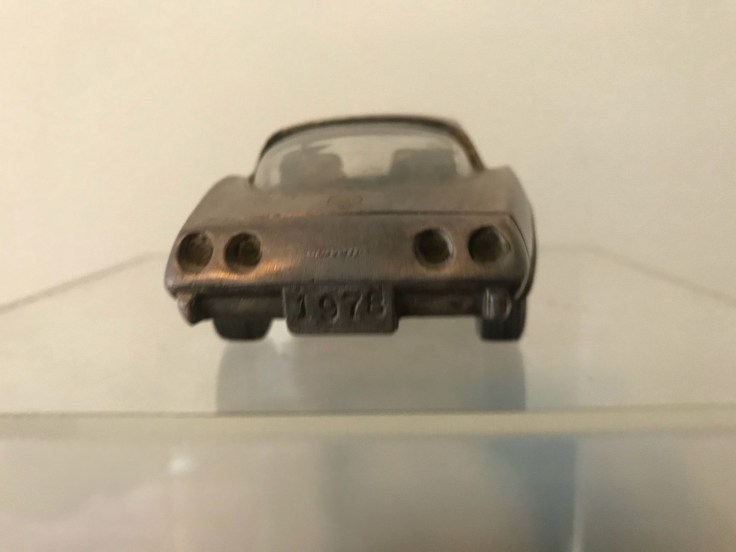
I’m super excited to share this item that was shared with me this week by Paul W., who found the blog and sent the story with pictures to me. Although it’s not a poured bar, this is a piece of vintage silver obtained from B.R. MacKay & Sons out of Utah and made by Balfour Merchandising Company out of Texas. I have to say this is one of the more interesting pieces I’ve seen in quite awhile. Paul’s father was a Chevrolet dealer in the 70’s to early 80’s. The dealership was Don Allen Chevrolet in Miami. These silver corvettes were only offered to the top selling dealers in the US at the time and only 80 were made. Paul’s item is #50. It came with a notarized letter from Balfour along with a jewelers appraisal. It weighs 4 pounds and 99.9% sterling silver. Great piece of Americana. Enjoy the images below.

Side view.
Side view part 2.
Super cool, 1978 plates.
Rear view plates.
Underside. Really great detail here.
Here is the marketing piece for the 25th Anniversary. Very cool!
Letter from Balfour, the maker, stating silver obtained from B.R. MacKay.
Letter of appraisal.

Hope you enjoyed this post. I welcome any of the readers of this blog/site to please feel free to share pieces from your collection. We are always looking to add and update new content that others can enjoy and learn from. Take care all.

1 Oz Class Silver Smalls

Finally getting through the majority of the “Smalls.” It’s been a work in progress for quite some time. Hope you enjoy.

Scarce 1 oz variety from Hallmark Precious Metals Inc. They were in business from 1974-2004 and operated out of Mercer Island, Washington, as well as a few other locations in Washington.
Reverse pic.
The obverse of the mysterious “J” ingots. These are neat pieces. I have a 5 oz piece featured in an earlier blog post.
“J” stamp on reverse of ingot.
Top is 1st gen Silvermat (very tough bar to find). Bottom is second gen Silvermat (found more often).
Love the mold of the top first gen Silvermat.
A few really cool varieties of Tombstone AZ pieces from Brian R’s collection.
Reverse pic of the two Tombstone pieces.
Two varieties of 1 oz class BRC (Bahamian Refining Company) pieces. Love this Eagle design on the left.
Right non Eagle variety has great patina and different weight and purity design at bottom of the bar.
1 oz class Casey Refining ingot.
Very cool trapezoid style with excellent patina and Eagle stamp on obverse.
Name, weight and purity on reverse.
Rare 1 oz Johnson Matthey Canada, Sandon B.C. ingot.
JMC stamp a bit faint, but such a hard bar to come by. Happy to have it.
This a a neat piece, KML with a Simmons like hallmark. Not much known on these, but they have been commanding very nice premiums when they come up.
Nice looking reverse.
1 oz Global Metal Refiners ingot.
View of top and side stamps.
Neat Virginia City, NV Comstock piece. These are more modern, but were done in very limited quantity.
1 oz class Alexander Westerfeld, Aztec Sun.
Obverse of the AW.
Very high premium 1 oz class Keiffer. Big fan of these.
Reverse of Keiffer.
1 oz Liberty Mint ingot.
Liberty Mint hallmark above. One of the more unusual hallmarks you will come across. Just a box with a line going through it. Not sure what it means.
More modern, but very scarce Prospector’s Gold & Gems first gen 1 oz pour.
Reverse of the PG&G piece is killer.
Very unusual old pour that I picked up about 5 years ago. No idea on this one.
It’s from Arizona and has a GM stamp on the side.
Purity on one side.
16.7 grams.
Non hallmark, but very old in my opinion. It has a Midas Metals look to it, but the mold is very similar to the old Omega 1 oz pours.
Side view.
Beautifully toned reverse.

Smaller Weight Vintage Ingots From Around the World

Over the last several years, I’ve tried to add unique vintage ingots from various parts of the World. Today I’m going to share a handful of 2+ oz to 100 gram size pieces from various countries. Enjoy.

This came as part of a 4 ingot set (all 100 gram) in 1969. The EI is Engelhard International (Refiner), the Crown is the Sheffield Assay Office hallmark, the seated Britannia represents purity, and the B indicates year (unknown).
Reverse pic.
100 gram Morris and Watson piece from Australia. Not sure of the year, but this is a well done ingot with great lines.
Reverse side of the MW.
Exceptionally rare S.R. Mitchell (Australia) ingot. Estimated mintage <5 in 77 gram class. This particular ingot is 76.2 grams and 2.45 troy ounces. One of the rarest pieces in my collection. Stanley Robert Mitchell, the founder, became a gold assayer in 1911 (significance of date stamp on ingot) and started S.R. Mitchell & Co Pty in the 1920’s. This ingot is likely a 1970s era piece. The company was believed to have been in business until sometime in the 1980’s era.
Reverse pic.
This is a really neat 5 Tolas piece with great toning and detail. Made by M/S Manilal Chimanlal & Co. out of Bombay, India. This weighs 1.88 troy oz. These are generally found beat up. I was fortunate to find such a pristine example.
Gorgeous design!

For other international ingots, check out my blog on Perth Mint and Harringtons, where you can see some other gems from Australia.

Notable 2 Oz Class Ingots

Today, I’m covering a handful of known vintage 2 oz class ingots. “Silver Smalls” is one of the fastest growing segments of the vintage silver collectibles market and has been hot for some time. I think these are a fantastic store of value.

2 oz Keller ingot. My understanding is that these were made for clients and employees for a Keller RealEstate firm years ago. More information would be welcome on these.
Reverse of the 2 oz Keller.
Oregon Gold and Silver 2 oz class. Very tough bar to find.
Phenomenal lines of the reverse of this 2 oz OGS.
Possibly made by OGS and likely so, this M/C is the same mold and stamps. I don’t know the refiner, unfortunately. Help welcome!
2 oz class Global Metal Refiners ingot. I’ll be sharing a 1 oz shortly in a separate blog entry.
One of my favorites is this 2.3 oz Doral (NY bar).
Side view with incredible toning and layers.
Reverse of the Doral ingot. Fantastic piece.
Not poured, but extremely rare 2 oz class SOA from Draper Mint. These are nearly impossible to find. My theory is they split a small number of 5 oz class extruded into these smaller varieties. Note the 2 in the weight is stamped over a 5. Love this bar.
This shows the detail and some toning better than the first pic. Better view of the 2 stamp over the 5 in this image.
Old P.C. poured ingot. Not sure of the refiner, but a cool old pour.
Reverse pic of the P.C.
2 oz Class poured FJS and Volkswagen commemorative piece.
Definitely made by same company.
J & J Smelting and Refining (CA bar) made in same mold as Omega and NCM 2 oz. This is the only one I’ve seen in 2 oz class.
Reverse pic of the JJSR
2 oz The Boatmen’s National Bank (courtesy of Brian R.). These are beautiful pieces.
Only 1,000 were made and given to first 1,000 customers for opening Bank Accounts from what I understand. See example of assay paper give below, but not for this ingot pictured.
Found this online through research, showing a 9/1/70 date of issue from The Boatmen’s National Bank of St. Louis for ingot No. 397. Very cool.

Notable 1+ oz Hallmarks

I’ve said it before, but the genre of “Silver Smalls” collecting is and probably always will be my favorite area of focus. I believe for value and holding premiums, this is where you get the most bang for your buck and it’s no surprise that scarce vintage 1 oz and 1+ oz pieces carry the biggest per oz premiums. Enjoy these beauties.

Alkin 1.67 troy oz ingot. These are really neat pieces that rarely come up for sale.
Nice character on reverse.
Rare Vulcan Refinging 1.47 troy oz piece from El Paso, TX
Reverse pic.
Extremely scarce Balthrop & Co. ingot, 1.09 troy oz.
Really unique piece. Only one I’ve ever come across.
1.15 troy oz Alexander Westerfeld Aztec Sun with asbestos glove marks on the ingot. This is the reverse side.
Obverse of the AW with purity stamp.

3 oz Hallmark Varieties

I thought I’d do something different today and share some different varieties of various 3 oz hallmarks. Some of these are high up on my favorites list.

3 oz class L.C. Murray, non torch hallmark variety. This is likely the first gen type one with the second gen 3 oz showing the torch hallmark. Love the picture frame.
Reverse pic.
4th series 3 oz Engelhard. Love the lines on this piece!
Reverse pic.
Two varieties of Johnson Matthey Canada 3 oz Maple Leaf hallmark ingots. These came as part of a set offered in 1965. The bottom ingot has a a different font for the “3.” It’s a rare variety estimated at <250.
Incredible patina on the reverse of these.
Neat 3 oz piece from Draper Mint (Utah).
Reverse shows their iconic Swiss of America hallmark with the mountains in the background.
Another really unique piece is the 3 oz International Silver LTD. Inc. 3 oz flat poured ingot.
Reverse is the hallmark for a KXOK AM 63 radio, which was a station in St. Louis.
SSS old pour! Neat 3 oz pour.
Killer character on reverse.
Comstock mold on this 3 oz LCE piece, which to date is still a mystery. Love this ingot!
Hallmark on reverse. Someday this mystery will be solved.

Introduction to Collecting Silver Ingots

I found the love of collecting old poured silver ingots about 5 years ago. Collecting vintage bullion just comes down to what you love, what catches your eye. It becomes an obsession from there.

Many of the bars I collect, were poured in the late 60’s and 70’s, through mid 80’s. There was an abundance of companies pouring silver at this time, however it came to a roaring halt on Silver Thursday, which was an event that occurred in the United States on March 27, 1980 following the attempt by brothers Nelson Bunker Hunt, William Herbert Hunt and Lamar Hunt to corner the silver market. Silver had reached a high of $50/oz at that time. What happened to all those beautiful old poured bars you might ask? Most of the melting took place in 1979 and 1980, when silver bullion soared to an all-time high of $50 an ounce. At that point, the silver bars were worth far more as metal than as money or collectibles. Hence the Great Melt occurred and created a whole new market for collecting.

Vintage can mean different things to different people, but to me, it’s any bar produced from mid 1980s and earlier. Again, there is no hard or fast rule here, just a guideline on what’s considered vintage.

Collecting can encompass everything from 1 oz to 100 gram pieces, which I refer to as “silver smalls” to 5, 10, 20+, 50+ and 100+ oz pieces.

With this blog site, my goal is to showcase and chronicle my collection alphabetically, putting pieces in “alphabetized boxes.”

Hope you enjoy the journey as much as I do.

Incredible Example of a 5 oz class Consolidated Mines & Metals ingot. They produced these ingots out of San Francisco, CA. Just a spectacular hallmark. One of my favorites.
Serialized reverse. Pristine example

Powered by WordPress.com.

Up ↑